
Arizona Court Records After Arrest
After an Arizona jail arrest, booking information and court information can diverge quickly. The jail roster reflects intake, custody, bond fields, holds, facility location, and the charge language available to the jail at that point. The court record reflects what a prosecutor files, what the court accepts, what hearings occur, what bond or release conditions are ordered, and how each charge is resolved. A roster entry can be useful, but it should not be treated as the final filed charge or case outcome.
The statewide court path starts with Arizona Public Access Case Lookup for index-style discovery, then moves to eAccess, a county clerk, a justice court, a municipal court, or the court of record for documents and certified copies. Use inmate records for custody and roster status, and use jail rosters and mugshots only for booking-photo questions. Court records after a jail arrest are the source for filed criminal charges, hearing history, orders, dispositions, and sealing status.
Arizona Arrest Court Routing
Arizona court routing is statewide but not universal. Public Access Case Lookup is a statewide index-style portal that the research describes as covering case information from 177 of 184 courts. It is CAPTCHA-gated, updated weekly each Friday to reflect information through Wednesday, and not the official court record. eAccess provides 24/7 online access to many Superior Court civil and criminal records filed on or after July 1, 2010, with the Pima County criminal-record exception noted in the research.
Local justice, municipal, and clerk channels still matter for older records, certified copies, local ordinance matters, restricted records, and records not online. A Phoenix, Tucson, Flagstaff, Yuma, or border-area arrest can move through city court, justice court, Superior Court, federal court, tribal court, or immigration channels depending on the facts. The court record after a jail arrest follows the court of record, not the jail that booked the person.
Find Arizona Court Records After Jail Arrest
Start with Arizona Public Access Case Lookup for index-style discovery, then use eAccess or the clerk/court of record for documents. Public Access is useful when a jail roster shows a name but the user needs the case number, court, filed charge, hearing list, or disposition. It is not the official record and should be verified with the court that holds the file.
The Arizona Public Access Case Lookup portal is the statewide case-search starting point described in the research.
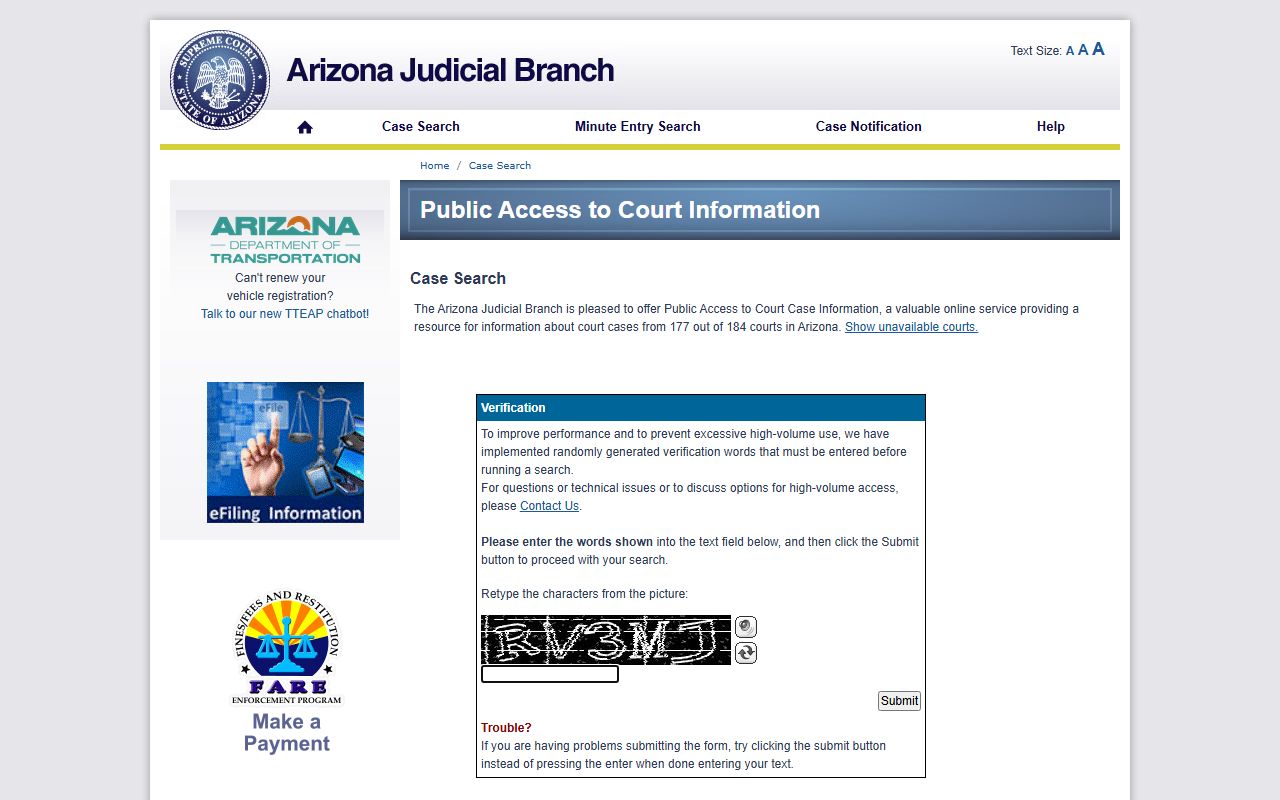
Use it to locate a case, then verify official details with the court of record.
- Start with the jail roster or booking source if custody is still unknown, then note the person's name, booking date, county, and charge language.
- Search Arizona Public Access Case Lookup by defendant name or case number when a statewide index search fits the case.
- Use eAccess or the court of record for supported Superior Court documents, charging papers, docket entries, and copies.
- Check local justice, municipal, county clerk, federal, or tribal court channels when the statewide portals exclude or do not show the case.
- Compare the filed charges, bond orders, hearing history, and disposition with the jail roster because the court record can change the charge language.
To find the correct local route after identifying the county, use the County Directory.
Arizona Charging Documents After Arrest
Booking happens at the jail; the court case begins when a complaint, indictment, information, citation, or other charging document is filed. A jail charge is not always the prosecutor's final filed charge. Arizona court records after a jail arrest should be checked for the exact document that opened the case, the court that accepted it, and any later amendment. That is why the court file can look different from the jail roster even when both concern the same arrest.
The Arizona eAccess portal provides an online document route for supported Superior Court records.
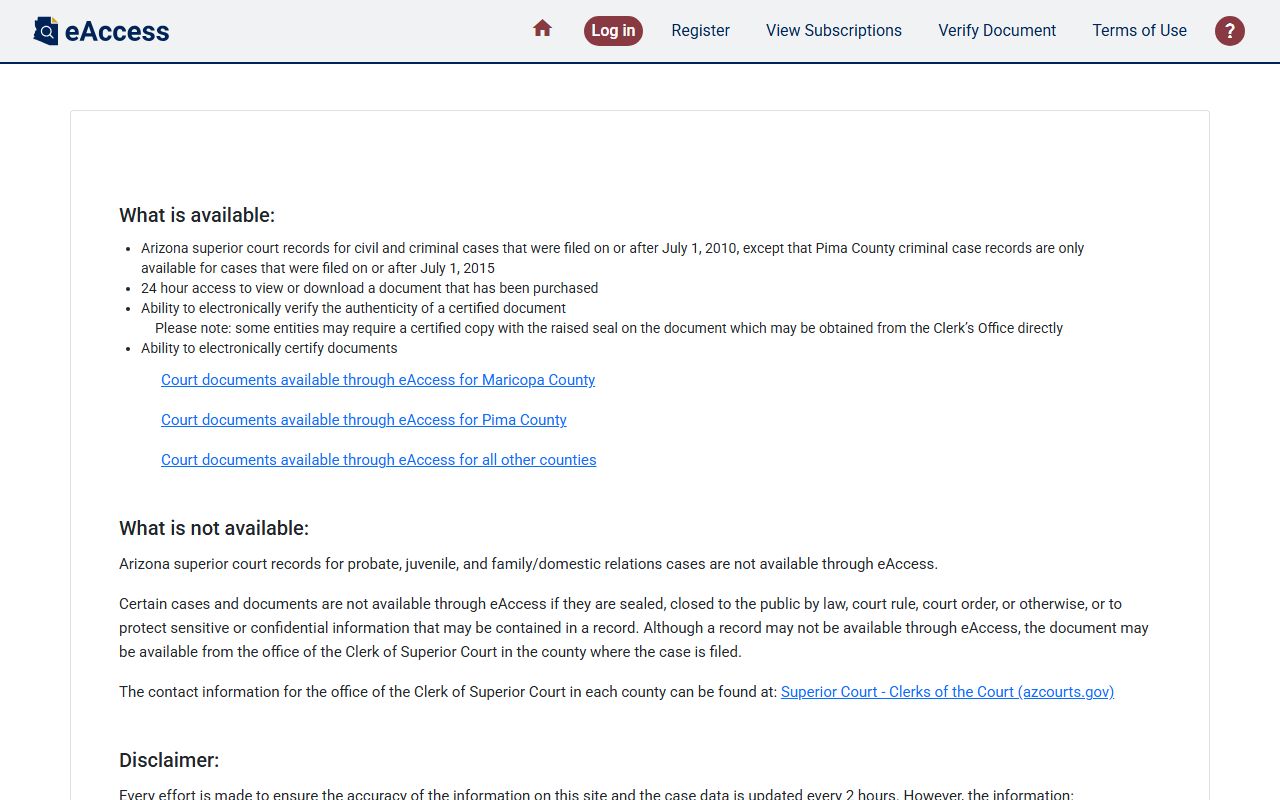
Document access is especially useful when the user needs the charging document rather than only a roster or index entry.
| Document | Who Files It | How It Fits the Arrest Case |
|---|---|---|
| Complaint | Officer or prosecutor | Often starts a criminal case and may use charge language that later changes. |
| Information | Prosecutor | A formal prosecutor-filed charge document, often used after review of the arrest and evidence. |
| Indictment | Grand jury | A grand-jury charging document used in some felony cases and serious matters. |
Note: A charge listed in a jail booking tool is an arrest-stage label; the charging document is the court-stage source.
Arizona Charge Status Records
Charges can be amended, reduced, added, declined, dismissed, or resolved by plea, verdict, diversion, or another court order. A jail roster may still show original booking wording because the custody system is not built to explain every later court event. Always use the court record for the current filed status, then confirm official copies with the clerk or court of record when the result affects bond, release, employment, housing, licensing, or legal decisions.
| Status | What It Means |
|---|---|
| Pending | The case or charge remains open and has not reached final disposition. |
| Amended / Reduced | The prosecutor or court record changed the filed charge from the original language. |
| Added | A later filing added another charge after the first booking or complaint. |
| Dismissed | The court record shows the charge or case was dismissed. |
| Declined / Not Filed | The prosecutor may decline or not file a charge even if the jail booking showed one. |
| Disposed | The charge reached a plea, verdict, sentence, diversion, or other final court outcome. |
Arizona Bond After Arrest
Bond and release terms are set through the court process and can change after first appearance, new charges, warrants, holds, or agency transfers. County jail rosters may show bond fields, but the court order controls release conditions. If a jail roster says a person is held without bond, the cause may be a warrant, detainer, probation matter, immigration hold, new charge, court remand, or another agency's request. The court record after a jail arrest is the better source for orders and hearing events.
| Bond Type | How It Works |
|---|---|
| Cash Bond | Release requires cash payment under the court's terms. |
| Surety Bond | A bail-bond process may satisfy the court-ordered bond when allowed. |
| PR / Own Recognizance | Release without paying a cash bond, subject to court conditions. |
| No-Bond Hold | Release is blocked until the court or holding authority changes the hold. |
Arizona Charges vs Convictions
An arrest, booking entry, warrant, charge, or jail search result is not proof of guilt. Conviction requires a plea, verdict, or other court disposition. Arizona court records after a jail arrest may show a pending charge for a long period before the status changes, and a charge can be dismissed or amended before any conviction occurs. Verify outcomes with the court of record rather than relying on a jail roster or a copied search result.
| Charge | Conviction | |
|---|---|---|
| Stage | Accusation after arrest or filing | Plea, verdict, or other adjudication |
| Meaning | The person is accused of an offense | The court has entered an outcome on the offense |
| Where to verify | Charging document and docket | Disposition, minute entry, judgment, and sentencing record |
| Risk when misread | Can be mistaken for proof | Can be outdated if later sealed, set aside, or corrected |
Important: Arrest, booking, warrant, charge, and custody records should not be described as convictions unless the court disposition says so.
Arizona Sealed Arrest Records
Arizona provides a sealing path for eligible arrest, conviction, and sentence records under A.R.S. 13-911. Eligibility depends on the case outcome, waiting periods, offense category, and court order. Sealing does not rewrite every third-party copy or every agency record automatically, and it does not make a restricted record visible through the public court portals. Some juvenile, victim, witness, mental-health, probate, sealed, and confidential categories are excluded or restricted by rule, portal design, or court order.
The Arizona Legislature public-records statutes page supplies the broader statutory context for records access and limitations.
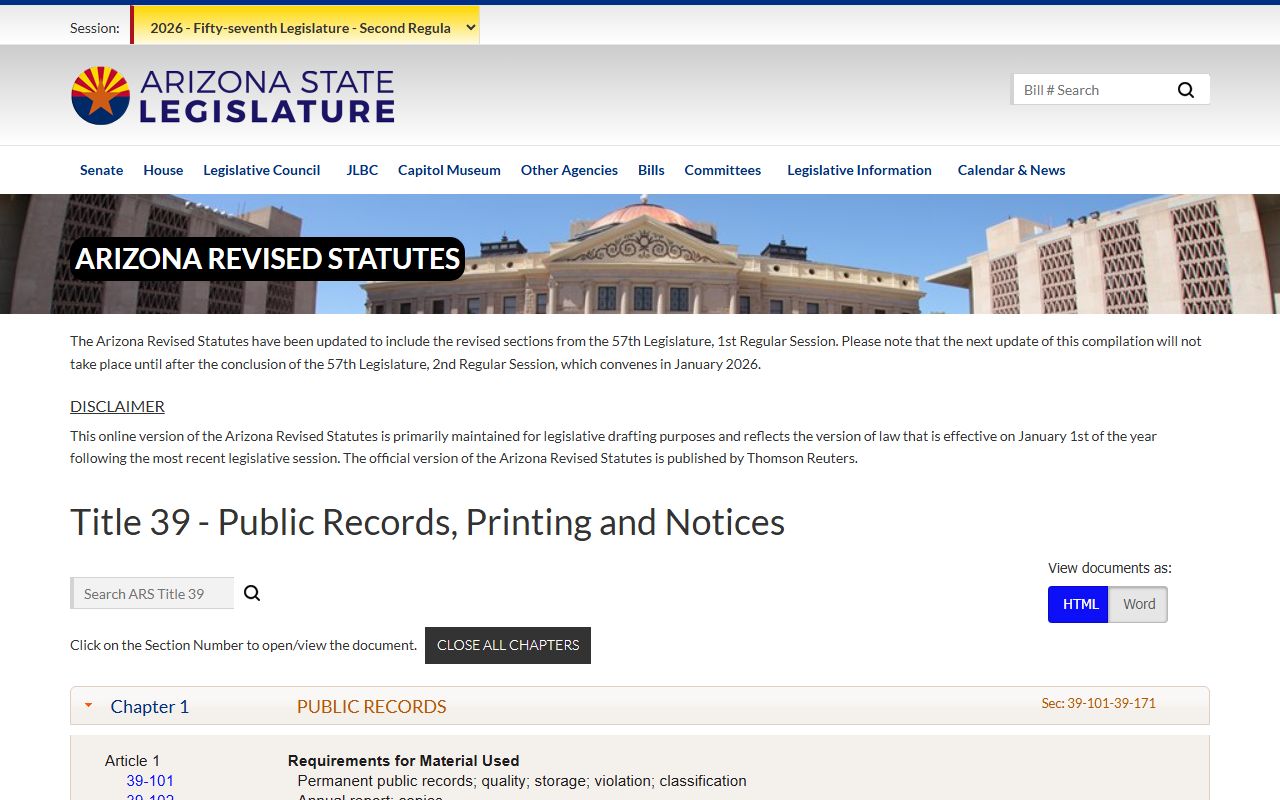
Sealing and access questions depend on statute, court order, and the record custodian.
| Sealed | Expunged | |
|---|---|---|
| Public visibility | Generally hidden from ordinary public access after a court order | Often used casually, but Arizona adult relief is commonly framed as sealing under A.R.S. 13-911 |
| Agency access | Some agency or legal access may remain depending on the law and order | Depends on the specific legal authority and record type |
| Eligibility | Depends on the arrest, conviction, sentence, waiting period, offense category, and court order | Juvenile and special record categories follow separate rules |
| Search effect | Public portals may stop showing the record or limit detail | No public search promise should be made unless the order and law say so |
Arizona Court Search Fields
Arizona court search fields vary by portal and court, but the main post-arrest lookup fields stay consistent across most case-search paths. Public Access is used for case discovery. eAccess and clerk channels are used when the user needs document access, a certified copy, or a file that the public index does not fully display.
| Field | Where It Helps | Search Note |
|---|---|---|
| Defendant name | Public Access, local court portals, clerk searches | Use first and last name, then confirm by county, date, and charge. |
| Case number | Public Access, eAccess, clerk channels | Most precise field once the case has been located. |
| Court or county | Statewide and local routing | Needed when common names return multiple Arizona court records. |
| Filing date | Document access and clerk requests | Useful because eAccess has filing-date scope limits for supported records. |
| Charge or violation | Docket review | Verify against the charging document and later amendments. |
Public Access, eAccess, and local clerk records are search tools, not substitutes for legal advice or official certified records.
Restricted Arizona Court Records
Arizona Public Access and eAccess exclude or restrict sealed cases, confidential records, juvenile delinquency/incorrigibility cases, mental-health and probate categories, victim/witness data, some local ordinance matters, and records unavailable online. Ongoing investigations and security-sensitive records may also be withheld or redacted. If a case does not appear, the reason may be a portal limit rather than proof that no arrest or filing occurred.
The Arizona VINELink page supports custody and case notifications but does not make restricted court records public.
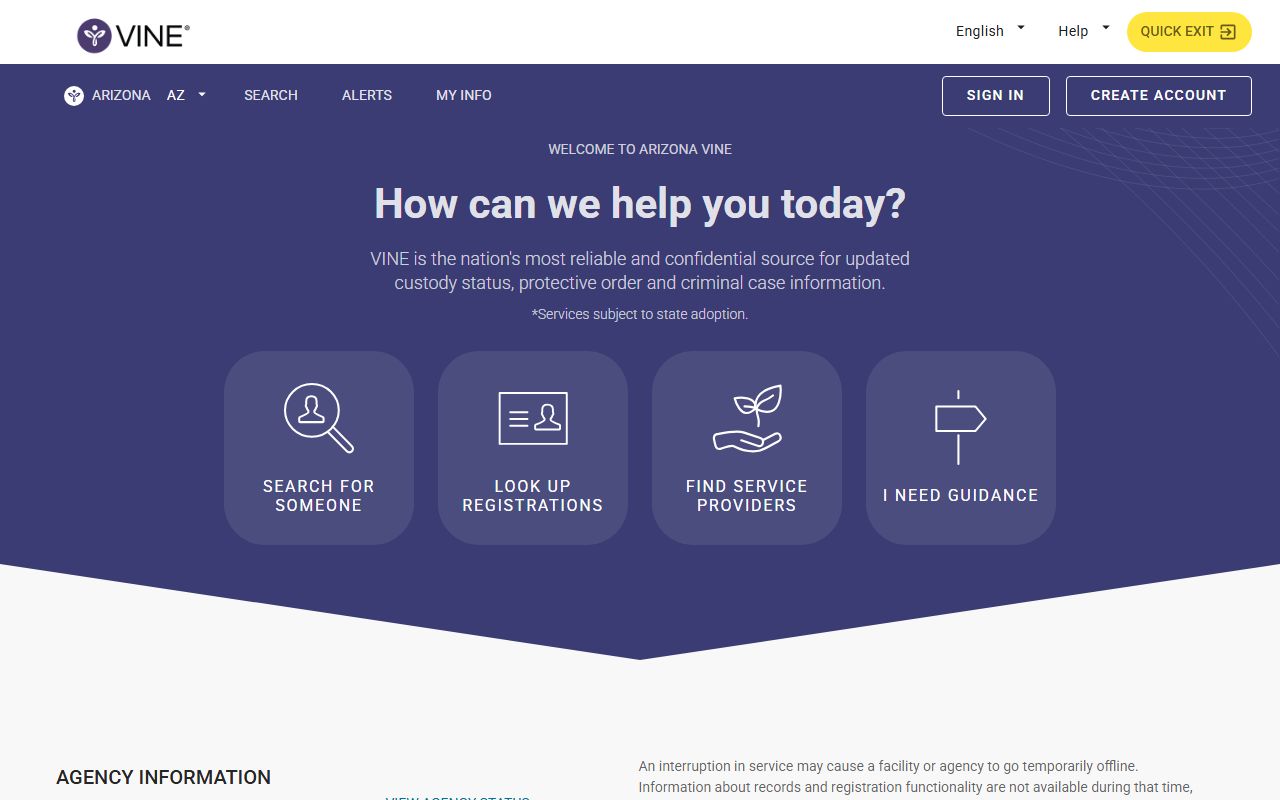
Notification access and court-record access are separate; restricted records still require the proper court or custodian route.
- Remand
- A court order returning or keeping a person in custody while the case continues.
- PR release
- Release on personal recognizance, meaning release without a cash bond but with court conditions.
- Detainer
- A hold or notice from another agency that can affect release from jail.
- Disposition
- The court's recorded outcome for a charge or case.
Note: Arizona DPS criminal-history records and warrant tools are separate from live jail rosters and court case portals.